In the field of precision manufacturing, grinding wheels are known as the “teeth of industry.” However, faced with a bewildering array of abrasives, grit sizes, hardness levels, and bonding agents, many manufacturing companies often feel confused when selecting the right grinding wheel. Choosing the wrong grinding wheel can not only lead to low processing efficiency but also damage expensive workpieces and even shorten the lifespan of the machine tool.
As a provider of high-end grinding solutions, Besdia has summarized the following four core dimensions to help you select the most suitable grinding wheel in complex application scenarios.
I. Determining the Abrasive Based on Workpiece Material
This is the first and most fundamental step in selection. The hardness of the abrasive must be significantly higher than the hardness of the workpiece.
CBN (Cubic Boron Nitride) Grinding Wheels: Designed specifically for ferrous metals (containing iron). If your workpiece is high-carbon steel, tool steel, bearing steel, or nickel-based superalloys, CBN is the only choice. It does not chemically react with iron at high temperatures and has excellent thermal stability.
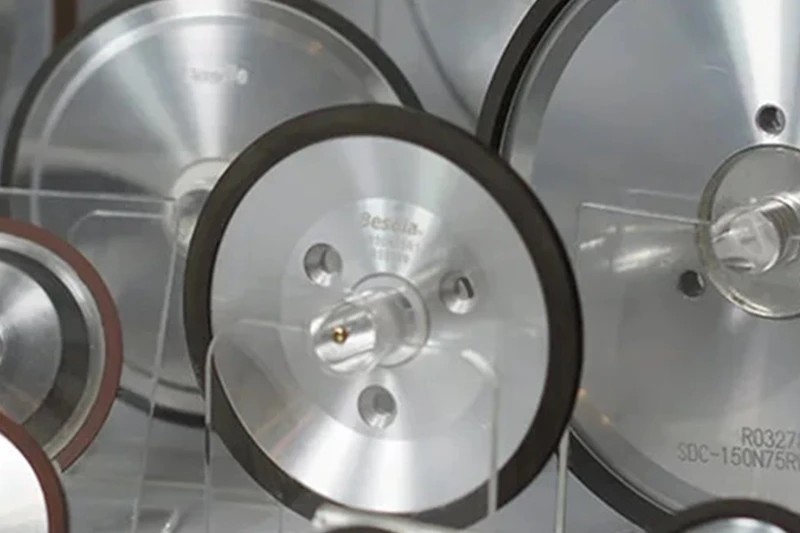
SDC (Diamond) Grinding Wheels: Designed for hard and brittle materials and non-ferrous metals. Suitable for cemented carbide (tungsten carbide), ceramics, glass, sapphire, semiconductor wafers, and various non-metallic materials.
II. Matching the Bond Type to Balance Efficiency and Lifespan
The bonding agent determines the “holding power” and “elasticity” of the grinding wheel during grinding.
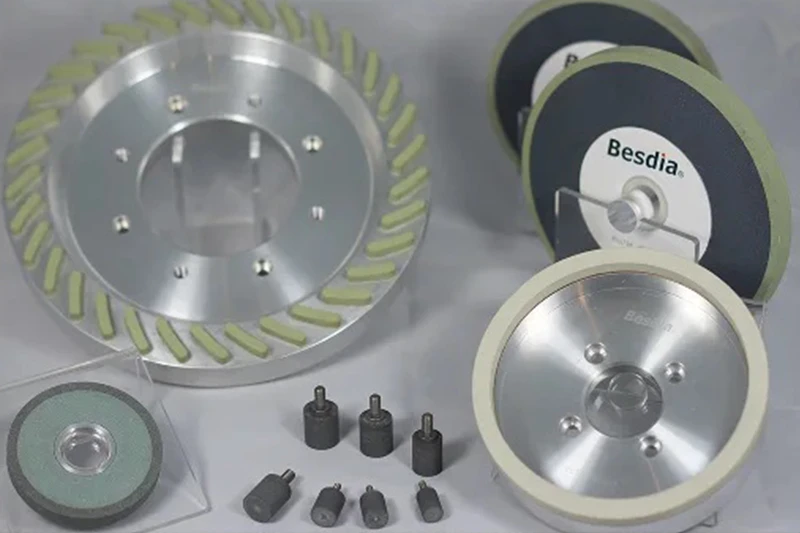
Resin Bond: Besdia’s core strength. It has good elasticity, low grinding heat, excellent self-sharpening properties, and can achieve extremely high surface finish. Suitable for precision grinding, polishing, and applications requiring very high cutting forces (such as Besdia’s large-scale surface grinding series).
Metal/Electroplated Bond: The strongest holding power, extremely high wear resistance, and good grinding wheel formability. Suitable for rough grinding, profile grinding, and heavy-duty grinding where the grinding wheel needs to maintain a consistent shape for extended periods.
Vitrified Bond: Porous structure, excellent chip removal performance, and superior heat resistance. Often used in fully automatic, high-efficiency CNC grinding. III. Grit Size Selection: The Trade-off Between Precision and Efficiency
The larger the grit number, the finer the abrasive.
Coarse Grinding (#60 – #120): Aimed at achieving high material removal rates. If you need to achieve a feed rate of 0.08mm, like with Besdia’s large surface grinding wheels, coarse grit sizes should be prioritized.
Semi-Precision Grinding (#150 – #400): Balances material removal rate and surface quality, and is the most widely used range in industrial applications.
Fine Grinding and Polishing (#600 – #3000 and above): Used to achieve a mirror finish. Besdia’s double-sided grinding wheels perform exceptionally well in these fine grit ranges, ensuring scratch-free workpiece surfaces.
IV. Focus on Grinding Conditions
When selecting a grinding wheel, Besdia engineers typically ask for the following key parameters:
Grinding Method: Is it dry grinding or wet grinding? If it’s dry grinding, the grinding wheel requires higher heat resistance.
Machine Rigidity and Power: High-power machines can handle harder grinding wheels, while lighter machines require “softer” grinding wheels to prevent chatter marks.
Linear Speed: Grinding wheels with different binders have their optimal rotational speed range. Ensuring the linear speed matches this range maximizes grinding wheel life.
V. Customization is the Ultimate Solution
Although standard models can solve 80% of the problems, for precision tools (step grinding), semiconductor wafers, or complex workpieces requiring five-axis machining, customization is the optimal solution.
Besdia offers full-range customization services from 10mm to 900mm. When selecting a grinding wheel, you only need to provide us with:
Workpiece name and hardness (e.g., carbide drill bit, HRC60).
Processing accuracy requirements (e.g., surface roughness Ra 0.2).
Current pain points (e.g., grinding wheel clogging, short lifespan, or insufficient efficiency).
Conclusion
Choosing the right grinding wheel is not simply a matter of procurement, but a precise technical matching process. Besdia doesn’t just manufacture grinding wheels; we are committed to assisting your production line in achieving faster speeds, higher precision, and lower costs through professional data support and process recommendations. If you still have questions about your current grinding process, please feel free to contact the Besdia technical support team. We will provide you with personalized application solutions.